
A short video clip that appears to have been filmed during a church service has gone viral across social media platforms, triggering a fierce debate about church dress codes, privacy, and the culture of public shaming.
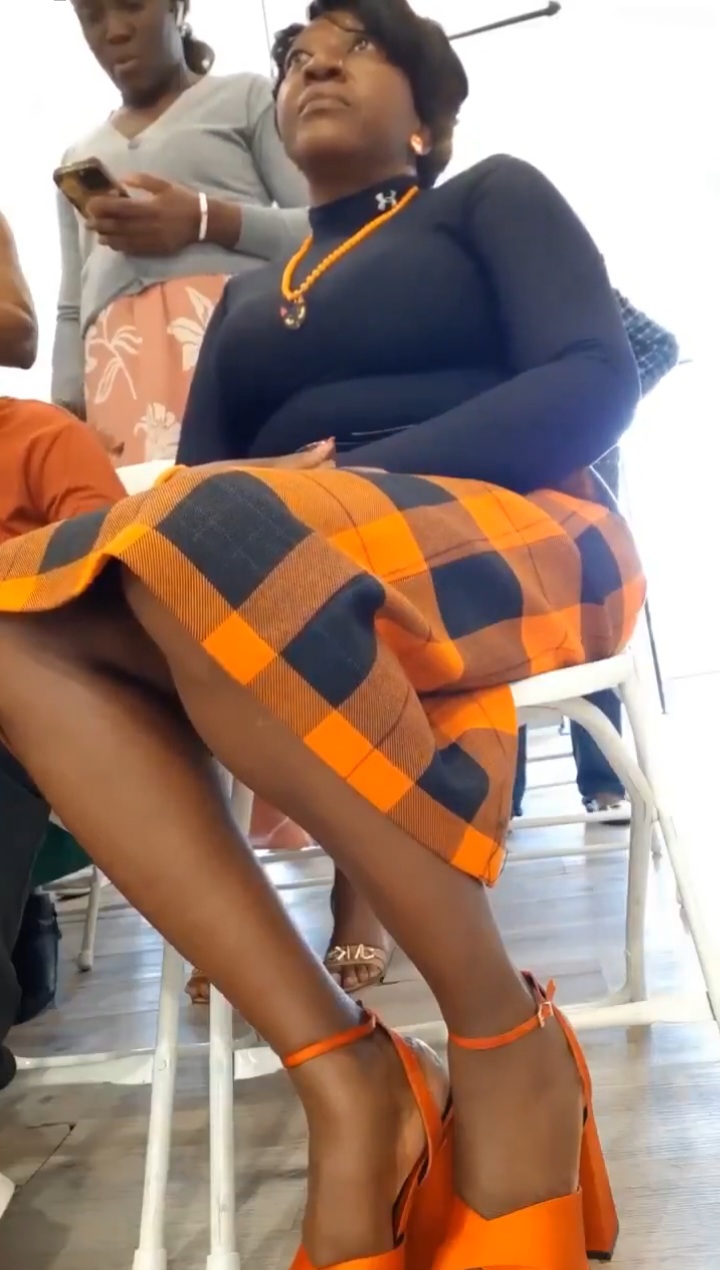
The clip, originally posted on X (formerly Twitter) by user @Weyne_west with the caption “this is someone’s mother doing this in the middle of a church service!
what on earth is this now?”, shows a woman seated in what looks like a church congregation. She is wearing a dark long-sleeved top and an orange and black checkered skirt.

The video is shot from a low angle, focusing on her seated position. In the background, another congregant can be seen standing and looking at a phone.
Within hours, the video had been viewed thousands of times and attracted hundreds of comments, ranging from moral outrage to defense of the woman and criticism of the person who filmed her.
What the Video Actually Shows and What It Doesn’t
Despite the sensational caption, the video itself is brief and ambiguous. It shows a woman sitting on a white plastic chair, hands clasped, listening to what appears to be a service.
The controversy stems not from any action she is performing, but from her attire and sitting posture, which some viewers deemed inappropriate for a church setting.
There is no indication of disruptive behavior. The woman is not speaking, standing, or drawing attention to herself. The camera, however, is positioned in a way that invades her personal space filmed from below, without her consent, in a place of worship where congregants expect a degree of privacy and dignity.

This detail has become a central point for many who have pushed back against the original post.
The Two Sides of the Debate
The reaction online has split into two distinct camps.
1. The Decorum Argument:
For many commenters, particularly older users and those who hold conservative views on church etiquette, the video represents a broader decline in respect for sacred spaces.
“Church is not a club or a street. There is a way we dress when we go before God,” one Facebook user commented. “As mothers, we must lead by example. What are we teaching our daughters?”
In many African churches, including in South Africa, Kenya, and Nigeria where the video has been widely shared, there is a strong, often unwritten dress code. Women are expected to dress modestly, often with skirts below the knee, covered shoulders, and sometimes a head covering.
The church is seen as an extension of the home and community, where one’s appearance reflects one’s family and upbringing. From this perspective, the woman’s skirt length and sitting position were seen as a violation of that communal standard.
Some have also linked the discussion to motherhood. The caption’s emphasis on “someone’s mother” was intentional.
It invokes the idea that mothers should hold themselves to a higher standard of modesty because they are role models. Critics of this view argue it is a form of gendered double standard that polices women’s bodies more harshly than men’s.
2. The Privacy and Compassion Argument:
A growing number of voices have defended the woman, turning the criticism back on the person who filmed and posted the video.
“Why are you filming someone’s mother in church without her permission from that angle? That is more disrespectful than what she is wearing,” a user on X replied. The post has over 400 likes.
This camp raises several important points. First, consent. Filming someone in a vulnerable position, from a low angle that emphasizes their body, and then posting it to thousands of strangers for ridicule, is a violation of dignity.
In many countries, this kind of non-consensual recording in a private gathering could even raise legal concerns.

Second, circumstance. We do not know the woman’s story. Did she borrow the skirt? Did it ride up as she sat? Is she a visitor who may not know the church’s dress code? Is she dealing with economic hardship that limits her wardrobe choices?
To judge her entire character from a 7-second clip is, defenders argue, the opposite of the Christian values the church is meant to teach grace, compassion, and non-judgment.
Third, the focus. “We go to church to focus on the Word, not to police each other’s skirts,” wrote one pastor who shared the video. “If your eyes are on a mother’s lap instead of the pulpit, who is really the one distracted from worship?”
A Reflection of a Bigger Social Media Problem
This incident is not isolated. It is part of a growing trend of “church shaming” content. Videos filmed inside churches capturing people sleeping, dancing excessively, wearing considered inappropriate clothing, or having emotional moments regularly go viral on TikTok, Facebook, and X.
The formula is simple: film someone in a sacred, often emotionally charged space, add a judgmental caption, and let the algorithm do the rest. The person filmed rarely has a chance to defend themselves, while the poster gains views and followers.
Sociologists call this “performative morality” where public shaming becomes a way for individuals to signal their own virtue. By calling out someone else’s perceived failing, the poster positions themselves as morally superior.
What gets lost is empathy. Places of worship are meant to be sanctuaries for the broken, the poor, the imperfect, and the struggling. They are, by definition, places where people come as they are. When we turn them into stages for public humiliation, we undermine their very purpose.
What Should We Learn?
The viral nature of this video offers several lessons.
For congregants and churchgoers, it is a reminder that true respect is shown not just in how we dress, but in how we treat others, especially when we have a camera in our hands.
If someone’s attire is genuinely a concern, the Christian approach would be a quiet, private conversation with a church leader or usher, not a public post.
For churches, it may be time to have a more open and compassionate conversation about dress codes. Instead of unwritten rules enforced by stares and gossip, some churches have opted for clear, kind guidelines posted at the entrance, and even keep wraps or shawls available for visitors who may need them.
For social media users, it is a call to pause before we share. Before we post a video of a stranger especially a woman, especially a mother, especially in a vulnerable setting we should ask: Is this true? Is it necessary? Is it kind? Would I want this done to my own mother?
The woman in the orange and black skirt did not ask to become a symbol in a culture war. She went to church. In a world that is quick to judge and quick to film, perhaps the most radical act is to let her worship in peace.
Watch Video: https://x.com/Weyne_west/status/2111732401416126479?s=20