
The African National Congress (ANC) has taken an early lead in the national proportional representation (PR) vote share following South Africa’s highly anticipated local government elections on 4 November 2026.
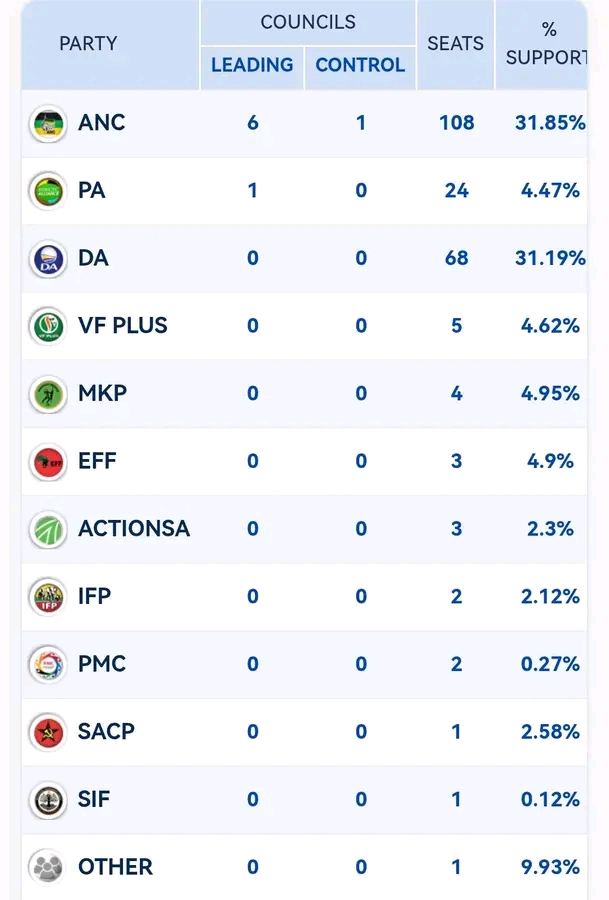
Data released by the Electoral Commission of South Africa (IEC) reveals a highly fragmented political landscape, with early tallies pointing to a surge in coalition governance across the nation’s most critical economic hubs.
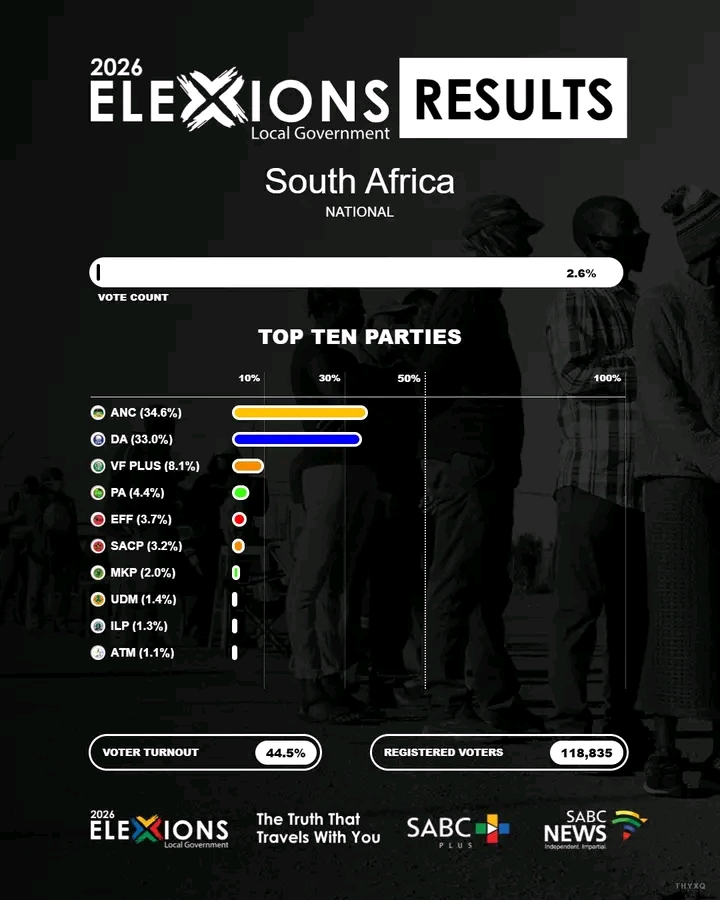
As results trickle in from thousands of voting districts, the ANC holds a narrow national edge with roughly 34% to 35% of the collective PR vote, according to early reports by SABC News.
The Democratic Alliance (DA) follows closely behind, capturing nearly 29% to 33% of the early national share.
While the ANC’s position at the top of the leaderboard offers a psychological boost for the ruling party, the municipal stage tells a radically different story.
Local government dominance in South Africa is determined council by council, and it is within these localized battles that the real shifting of power is occurring.
A stark contrast has emerged between rural margins and the country’s metropolitan centers. The ANC secured its first major symbolic victory in the Northern Cape’s Kamiesberg Municipality, where it won Ward 3 with 52.54% of the vote.
However, the DA has mounted a formidable challenge in urban areas, establishing comfortable or competitive leads in seven out of South Africa’s eight major metropolitan municipalities.
In Cape Town, the DA maintains a dominant position, though early figures reported by The National indicate its historical outright majority could face a slight reduction.
More fiercely contested battles are unfolding in Gauteng. In Johannesburg and Tshwane, early data places the DA slightly ahead of the ANC, setting the stage for tense, hung councils where neither major party secures more than 50% of the seats.
Similar leads for the DA have been observed in Ekurhuleni and Nelson Mandela Bay, while the ANC maintains its stronghold in Buffalo City.
The underlying mechanics of this election highlight a growing urban-rural divide. Initial reports highlighted a notable gap in voter turnout during the polling hours, with significantly higher turnout recorded in suburban areas compared to traditional township strongholds, according to an interim analysis by the Daily Maverick.
This differential turnout has significantly favored the DA’s electoral prospects in major metropolitan regions.
Meanwhile, smaller political entities, including the Patriotic Alliance (PA) and the Economic Freedom Fighters (EFF), are capturing crucial fractions of the vote, cementing their roles as vital kingmakers in upcoming council negotiations.
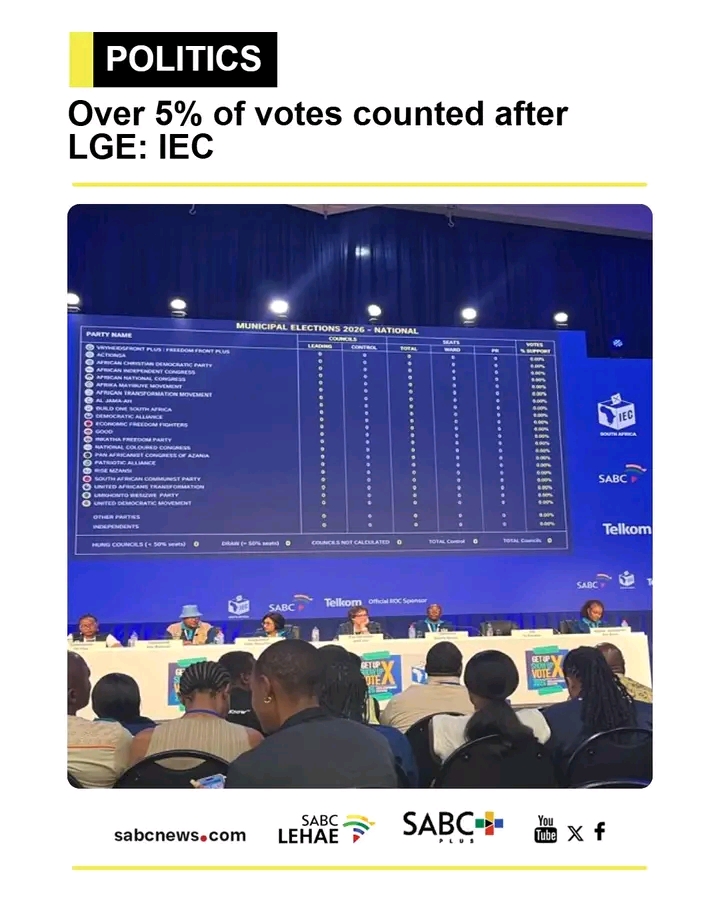
With the IEC meticulously verifying result slips alongside party agents and independent observers, the final allocation of council seats remains fluid.
The high probability of hung councils means that the true winners of the 2026 municipal elections will not be known when the final ballots are counted, but rather in the boardrooms where coalition agreements are hammered out.
South Africans now await the formal conclusion of the counting phase, which will usher in a complex, unprecedented era of local political alliances across the country.
